
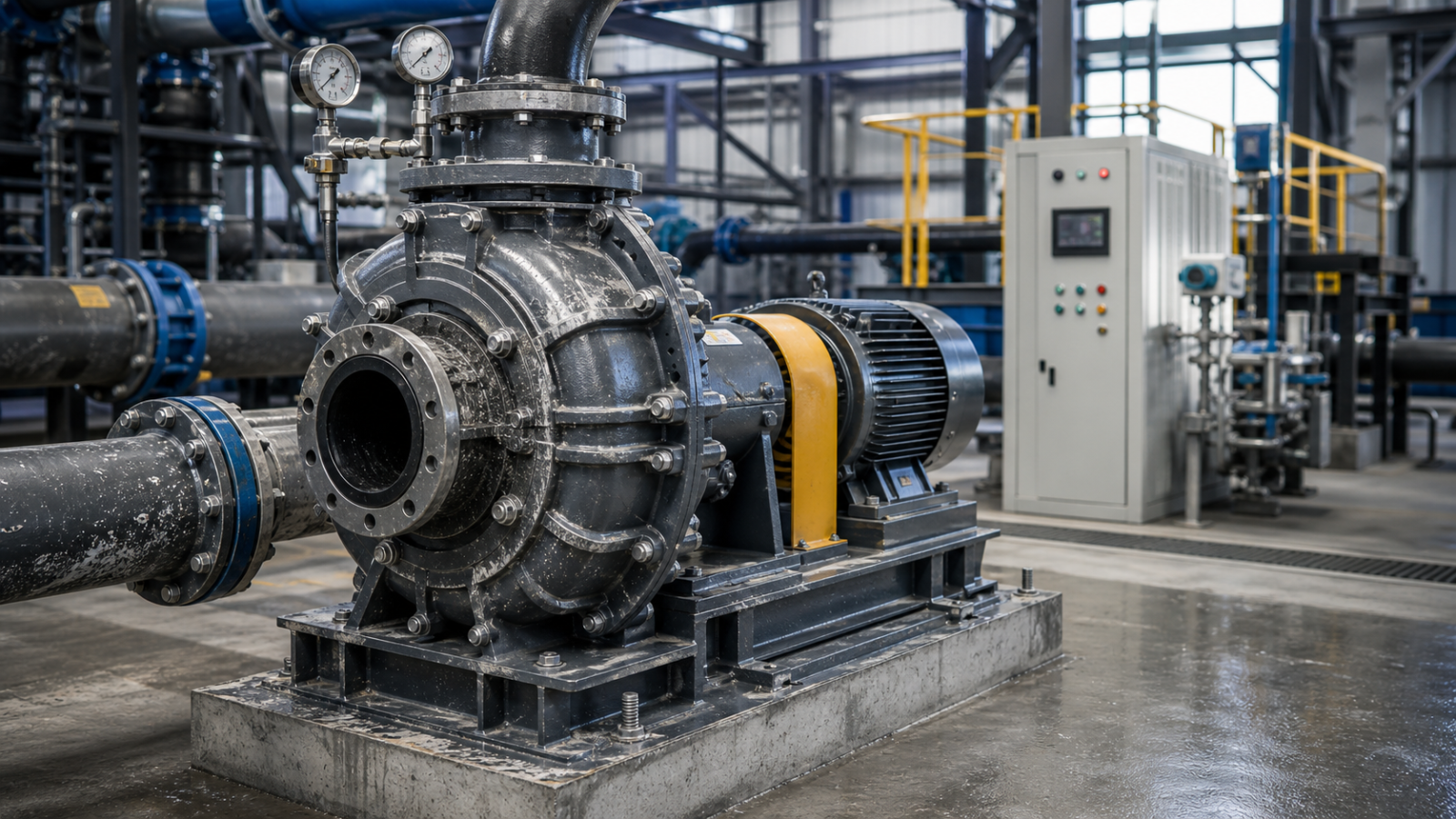
Selecting the right slurry pump and operating it correctly are critical steps in ensuring the efficiency and longevity of industrial fluid handling systems. Slurry pumps operate in some of the most punishing environments on earth, handling abrasive, corrosive, and high-density fluids around the clock. A single wrong material choice can reduce component life by 70% or more. This article provides a deep dive into the materials used in slurry pump construction—specifically high chrome alloy, rubber, and polyurethane—and outlines best practices for their usage and maintenance.
The Science of Wear: Understanding Abrasion Mechanisms

Before selecting a material, it is essential to understand how wear occurs in a slurry pump. There are two primary mechanisms:
Erosion-Abrasion: This occurs when hard particles slide across or impact the pump’s wetted surfaces, cutting or gouging material away. The severity depends on the particle’s hardness, angularity, and velocity. Coarse, sharp particles (e.g., crushed ore, gravel) cause aggressive gouging, while fine particles (e.g., silica tailings) cause gentler sliding abrasion.
Erosion-Corrosion: In chemically aggressive slurries (low pH, high chloride content), the pump material is simultaneously attacked by both abrasion and chemical dissolution. The two mechanisms synergize: abrasion removes the protective oxide layer, exposing fresh metal to corrosion, which in turn weakens the surface for further abrasion.
Understanding which mechanism dominates in your application is the first step to selecting the correct material.
Material Selection: High Chrome vs. Rubber vs. Polyurethane

High Chrome Alloy (A05/A33): The Standard for Hard-Rock Mining
High chrome white iron is the default material for hard-abrasive mining service. With a hardness approaching 60 HRC and a carbide-rich microstructure, A05 and related alloys resist cutting and gouging from fractured ore and sand. They handle high vane tip speeds without softening and retain their geometric profile longer than elastomers under identical solids loading.
- Ideal for: Cyclone feed, SAG mill discharge, dredge and sand slurries, and duties with high tip speeds and large eye diameters.
- pH Range: Suitable for mildly corrosive slurries, generally down to pH 4.
- Limitation: In highly acidic or reducing conditions, the metallic matrix corrodes, undercutting the carbides and accelerating material loss. High chrome is also heavier, increasing start torque and bearing loads.
Natural Rubber (NR) and Elastomers: For Fine Particles and Corrosive Chemistries
Natural rubber operates on a fundamentally different wear principle. At approximately 50–60 Shore A durometer, NR absorbs impact energy and tolerates recirculation scuffing without rapid cut growth. The result is smooth, uniform thinning rather than deep gouges.
- Ideal for: Fine silica tailings, hydrocyclone feeding in ore processing, chemical slurries, and applications where corrosion is the primary concern.
- Temperature Limit: Natural rubber is limited to approximately 65–70°C continuous service. Above this, the rubber softens and degrades rapidly.
- Limitation: Sharp, coarse solids can slice or peel elastomers, especially near the leading edge of the impeller vane. Rubber is also incompatible with oils and many organic solvents.
Polyurethane (PU): The High-Performance Middle Ground
Polyurethane sits between rubber and hard metal in the wear resistance spectrum. With a Shore A durometer in the high 80s to mid 90s, PU resists sliding abrasion and fights cut growth far better than natural rubber. In many fine silica and mineral sands applications, PU can deliver 3 to 5 times the service life of natural rubber.
- Ideal for: Severe abrasion with fine to medium particles, applications where oils may be present in trace amounts, and duties requiring an elastomer that holds its geometry longer under velocity gradients.
- Temperature Limit: Most mining-grade PU grades are comfortable to approximately 70°C.
- Limitation: PU is not suitable for hot caustic or hot acid environments, where hydrolysis and softening accelerate wear.
| Slurry Condition | Particle Size (P80) | pH Range | Recommended Material | Expected Life vs. NR Baseline |
| Fine silica tailings, neutral | < 150 µm | 6–9 | Polyurethane (PU) or NR | PU: 3–5x; NR: 1x (baseline) |
| Coarse, sharp ore (cyclone feed) | 1–10 mm | 7–10 | High Chrome A05/A33 | 4–10x |
| Acid leach slurry, fine | < 200 µm | 1–4 | EPDM or Lined NR | 0.8–1.2x |
| Sand transfer, dredging | 0.5–5 mm | 6–8 | High Chrome or PU | Metal: 4–8x; PU: 2–4x |
| Hot process water with fines | < 200 µm | 7–10 | EPDM or Stainless Steel | 1–3x |
Table 2: Material Selection Guide for Slurry Pump Impellers and Liners
How to Use and Maintain Slurry Pumps Effectively

Proper operation and maintenance are just as important as material selection. Even the best material will fail prematurely if the pump is operated incorrectly.
1. Operate Near the Best Efficiency Point (BEP)
Slurry pumps are designed for specific duty points (flow rate and head). Operating the pump too far off its Best Efficiency Point (BEP) can have severe consequences. Off-BEP operation increases recirculation at the impeller eye and through the wear ring gap, leading to asymmetric wear, mid-vane thinning, and potentially coating spallation on coated metals. Operating off-BEP can cut component life by 30 to 70 percent, regardless of material quality.
2. Manage NPSH to Prevent Cavitation
Maintaining adequate Net Positive Suction Head (NPSH) is crucial to prevent cavitation. Cavitation occurs when the local pressure at the pump inlet drops below the vapor pressure of the slurry, causing vapor bubbles to form and then violently implode against the impeller. This leads to pitting on the leading edges and shrouds, rapidly destroying the impeller. Always ensure the NPSH available (NPSHa) in your system exceeds the NPSH required (NPSHr) by the pump, with a safety margin.
3. Adjust Clearances Regularly
As the pump operates, the internal components wear, increasing the clearances between the impeller and the casing. This increased clearance reduces pump efficiency and increases internal recirculation. Regularly adjusting the axial clearance—typically via an adjustable screw on the bearing housing—helps maintain optimal performance. After any diameter trim, reset axial clearance per OEM specifications: too tight causes rubbing and heat-checking of metals or scorching of elastomers; too loose loses head and increases eye recirculation.
4. Implement a Proactive Maintenance Schedule

A structured maintenance program is essential for minimizing unplanned downtime. Key activities include:
- Vibration Monitoring: Unusual vibration signatures can indicate impeller wear and imbalance, bearing deterioration, or misalignment. Monitoring vibration trends allows for predictive maintenance before catastrophic failure.
- Liner and Impeller Inspection: Regularly inspect for signs of severe wear, cracking, or chemical degradation. Establish a baseline thickness measurement and track wear rates to predict replacement intervals.
- Shaft Seal Inspection: Ensure mechanical seals or packing are functioning correctly. Slurry leaking past the seal into the bearing assembly will rapidly destroy the bearings.
- Bearing Lubrication: Follow OEM-specified lubrication intervals and use the correct grease type.
Frequently Asked Questions
Q: When should I use a rubber-lined slurry pump instead of high chrome?
Use rubber-lined pumps when the slurry contains fine, smooth particles (P80 < 300 µm), when the fluid is chemically corrosive (acidic or alkaline), or when operating at lower speeds. High chrome is preferred for coarse, angular particles, high tip speeds, and mildly corrosive conditions.
Q: How often should slurry pump liners be replaced?
Replacement intervals depend heavily on the abrasiveness of the slurry, operating speed, and material selection. Establish a baseline wear rate by measuring liner thickness at regular intervals (e.g., monthly). When the liner reaches its minimum allowable thickness (per OEM specifications), schedule replacement during the next planned maintenance window.
Q: What is the most common cause of slurry pump failure?
The most common causes are: (1) incorrect material selection leading to accelerated wear, (2) operating far off the Best Efficiency Point causing recirculation and asymmetric wear, (3) insufficient NPSH leading to cavitation, and (4) neglected maintenance of shaft seals allowing slurry ingress into bearings.
Conclusion
Maximizing the return on investment for a slurry pump requires a comprehensive, engineering-driven approach. By carefully matching the pump’s construction materials to the specific slurry characteristics, operating the pump near its Best Efficiency Point, and adhering to strict maintenance protocols, industrial operators can significantly extend equipment life, reduce unplanned downtime, and lower their total cost of ownership.