
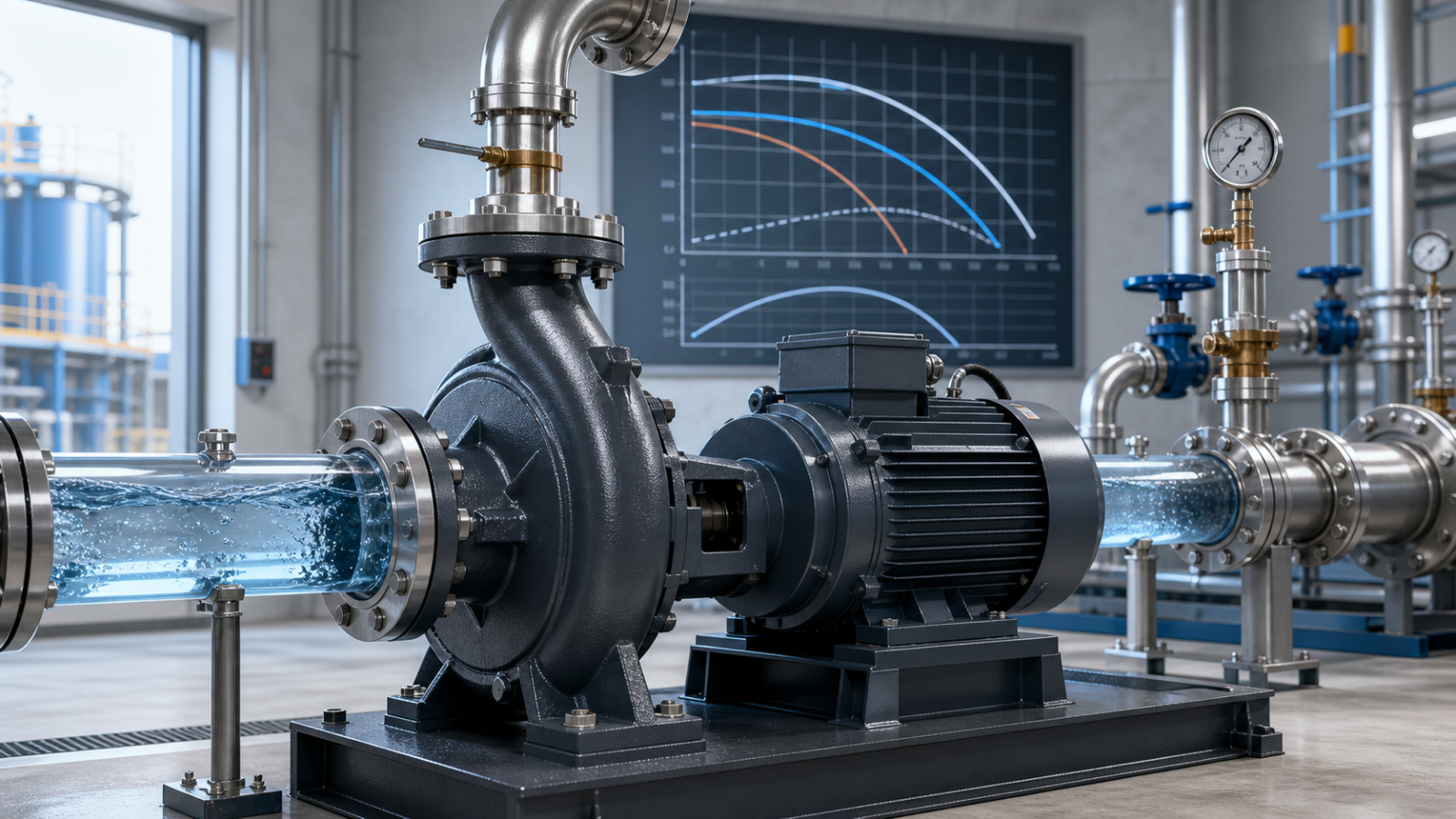
Selecting a clean water centrifugal pump involves more than just picking a size; it requires matching the pump’s materials to the water chemistry and carefully interpreting performance curves to ensure optimal efficiency. This article guides you through the critical choices between cast iron and bronze components and explains how to properly select a pump based on flow and head requirements—the two most fundamental parameters in pump engineering.
Material Selection: Cast Iron vs. Bronze Impellers

While the fluid being pumped is “clean” water, its chemical composition—pH, dissolved oxygen, dissolved minerals, and chloride content—can vary significantly between applications. The choice of impeller material is crucial to prevent corrosion and maintain pump efficiency over the long term.
Cast Iron Impellers: The Economical Standard
Cast iron is the standard, most economical choice for many clean water applications.
- Advantages: It is strong, widely available, and cost-effective. Cast iron provides excellent structural integrity for the impeller under high rotational speeds.
- Best For: Cast iron impellers are best suited for clean municipal water, closed-loop HVAC systems, and agricultural irrigation where the water is relatively neutral (pH 6.5–8.5) and non-corrosive.
- Limitations: Cast iron is highly susceptible to rust and corrosion if the water has high dissolved oxygen, low pH (acidic), or high chloride content. As the impeller rusts, its surface becomes rough. This roughness disrupts the laminar flow over the vane surfaces, increasing hydraulic losses and reducing pump efficiency. Over time, corrosion can lead to mechanical failure of the impeller.
Bronze Impellers: Superior Longevity in Open Systems
Bronze is a copper alloy that offers significantly superior performance in many water applications, justifying its higher initial cost through extended service life.
- Advantages: Unlike cast iron, bronze does not rust. When exposed to water, it naturally develops a stable, adherent protective patina (cuprous oxide) that shields it from further corrosion. This ensures the impeller maintains its smooth hydraulic surface, preserving pump efficiency over a much longer lifespan. Bronze is also naturally antimicrobial, which can be beneficial in potable water systems.
- Best For: Open-loop cooling towers (where the water is aerated and oxygenated), domestic potable water supply systems, systems with variable or uncertain water chemistry, and applications where long-term efficiency retention is paramount.
- Limitations: Bronze is more expensive than cast iron. It is also softer, meaning it is not suitable if the water contains any abrasive grit or sand, which would quickly erode the impeller vanes.
**Engineering Note:** Many manufacturers offer “Bronze-Fitted” pumps as a cost-optimized solution. These pumps utilize a cast iron casing (for structural strength and cost savings) paired with a bronze impeller (for corrosion resistance at the most critical, highest-velocity component). This hybrid approach provides excellent corrosion protection at a lower cost than an all-bronze pump.
Stainless Steel: For Aggressive Chemistries
For applications involving aggressive chemicals, seawater, or highly acidic/alkaline water, stainless steel (typically 304 or 316 grade) impellers and casings are required. Grade 316 stainless steel, with its molybdenum content, provides superior resistance to chloride pitting, making it the standard for marine and coastal applications.
| Material | Corrosion Resistance | Abrasion Resistance | Relative Cost | Best Application |
| Cast Iron | Low (rusts readily) | Good | Low | Neutral, closed-loop systems; irrigation |
| Bronze | High (forms patina) | Moderate | Medium | Open systems, potable water, aerated water |
| Stainless Steel 304 | Very High | Moderate | High | Food/beverage, mild chemicals |
| Stainless Steel 316 | Excellent | Moderate | Very High | Marine, seawater, aggressive chemicals |
Table 6: Impeller Material Selection Guide for Clean Water Pumps
How to Select and Use a Clean Water Pump: Reading the Performance Curve

The most critical step in using a centrifugal pump correctly is selecting the right one for the job. This is done using a Pump Performance Curve, which is provided by every reputable pump manufacturer.
Step 1: Determine Your System Requirements
Before looking at any pump curves, you must define two key parameters:
- Required Flow Rate (Q): How much water does your system need to move? This is typically expressed in Gallons Per Minute (GPM) or Cubic Meters per Hour (m³/h).
- Total Dynamic Head (TDH): This is the total resistance the pump must overcome, expressed in feet or meters of water column. TDH is the sum of:
- Static Head: The vertical distance the water must be lifted (from the suction source to the discharge point).
- Friction Head: The pressure loss due to friction as water flows through pipes, valves, elbows, and other fittings. This is calculated using the Darcy-Weisbach equation or pipe friction tables.
- Pressure Head: Any additional pressure required at the discharge point (e.g., a pressurized vessel or spray nozzle).
Step 2: Plot Your System Curve
The System Curve is a parabolic curve that represents the relationship between flow rate and the TDH required by your specific piping system. At zero flow, the TDH equals the static head. As flow increases, friction losses increase (proportional to the square of the velocity), causing the TDH to rise parabolically.
Step 3: Find the Duty Point on the Pump Curve
The Pump Performance Curve (or Head-Flow Curve) plots the head the pump can generate at various flow rates. As flow increases, the head generated by the pump decreases. The Duty Point (or Operating Point) is the intersection of the System Curve and the Pump Performance Curve. This is where the pump will actually operate in your system.
Step 4: Verify Efficiency and NPSH
- Best Efficiency Point (BEP): The pump curve will also show efficiency contours (or a separate efficiency curve). You want your Duty Point to fall as close as possible to the pump’s Best Efficiency Point (BEP). Operating near the BEP minimizes energy consumption, reduces vibration and radial thrust on the shaft, and significantly extends the life of the pump bearings and mechanical seals.
- NPSH Check: Always verify that the Net Positive Suction Head Available (NPSHa) in your system exceeds the NPSH Required (NPSHr) by the pump by a safety margin of at least 0.5 to 1.0 meter. Insufficient NPSHa leads to cavitation, which destroys impellers and causes severe noise and vibration.

Step 5: Avoid the Operational Extremes
- Operating too far to the left of BEP (low flow, high head): Causes excessive radial thrust, which bends the shaft and destroys mechanical seals and bearings. Can also cause recirculation at the impeller eye, leading to cavitation even with adequate NPSHa.
- Operating too far to the right of BEP (high flow, low head): Can lead to motor overload (exceeding the motor’s nameplate power), cavitation at the impeller outlet, and axial thrust issues in multi-stage pumps.
Frequently Asked Questions
Q: What is the difference between a cast iron and a bronze impeller?
A cast iron impeller is the economical standard, best suited for neutral, closed-loop water systems. A bronze impeller offers superior corrosion resistance because it forms a protective patina instead of rusting. Bronze is recommended for open systems, potable water, and aerated water where cast iron would corrode and lose efficiency over time.
Q: How do I read a pump curve?
A pump curve plots Head (pressure) on the Y-axis against Flow Rate on the X-axis. To use it: (1) Calculate your system’s Total Dynamic Head (TDH) and required flow rate. (2) Find the intersection of these two values on the curve—this is your Duty Point. (3) Verify that the Duty Point is near the pump’s Best Efficiency Point (BEP) for optimal performance and longevity.
Q: What happens if a centrifugal pump runs at low flow?
Running a centrifugal pump at very low flow (far left of the pump curve) causes internal recirculation, which generates heat, vibration, and noise. This leads to accelerated wear of the impeller and mechanical seal, and can cause cavitation even when NPSH appears adequate. Always size the pump to operate near its BEP.
Conclusion
Maximizing the lifespan and efficiency of a clean water pump requires careful, engineering-driven specification. By upgrading to a bronze or stainless steel impeller in aerated or chemically aggressive water systems, and by meticulously sizing the pump using performance curves to ensure operation near the Best Efficiency Point, operators can achieve reliable, energy-efficient water transport that delivers a strong return on investment over the pump’s service life.